By July 4, 1776, the port cities of Charleston and Savannah were both home to established Jewish communities, whose members participated in, and were profoundly shaped by, the Revolutionary War that followed.
Below is a curated list of historic sites and primary sources relevant to understanding the American Revolution and its relationship to the Jews of Charleston and Savannah.
Sites
Georgia
Forging our Sacred Liberty: The Declaration of Independence and Religious Freedom in Savannah, 1733-1790 exhibit at Congregation Mickve Israel, 20 E. Gordon Street, Savannah, GA – up through January 2027
Old Jewish Burial Ground (1773) at Coyle Street, Savannah
This burial ground was established by Jewish patriot Mordecai Sheftall, who is buried there. During the 1779 Siege of Savannah, the Jewish cemetery wall was designated as the rallying point for the French and American forces that were defeated by the British Army. Around the corner is a burial ground established by Mordecai’s brother, Levi Sheftall. Those interested in visiting these cemeteries can contact B.H. Levy, Jr. at gentlesav1733@gmail.com.
Loyalists & Liberty: Savannah in the American Revolution exhibit, which will feature Mordecai Sheftall, at the Savannah History Museum, 303 Martin L. King, Jr. Blvd., Savannah, GA – opens July 3.
South Carolina
Francis Salvador only arrived in South Carolina in 1773, but was elected to its Provincial Congress. Shortly after the Declaration of Independence he was killed in battle. See also: “Jewish South Carolinians and the American Revolution,” The Jewish Historical Society of South Carolina (Spring 2025).
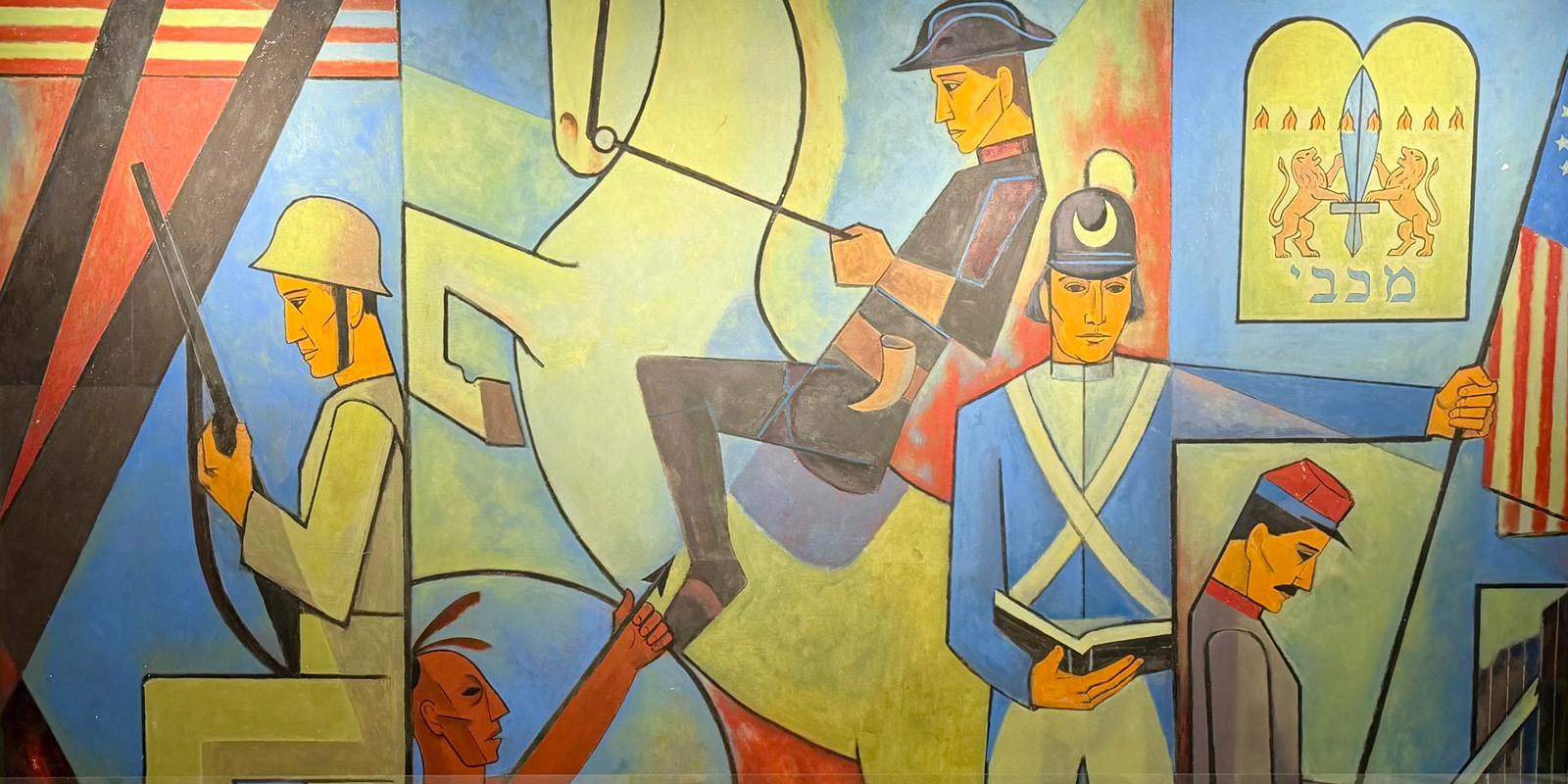
William Halsey Mural (1950) featuring Francis Salvador, Revolutionary War casualty, at Kahal Kadosh Beth Elohim, 90 Hasell Street, Charleston, SC
Francis Salvador Memorial, City Hall Park, Charleston, SC
Francis Salvador Historical Marker, intersection of Christian Road (Old State Highway 72) and Laurens Highway (State Highway 221), Greenwood, SC
The Battle of Seneca Town Marker is near Clemson, South Carolina, in Pickens County.
Kahal Kadosh Beth Elohim Cemetery – 189 Coming Street, Charleston, SC
Includes nine graves of Jewish revolutionary war veterans (not including Francis Salvador, although his uncle Joseph Salvador is buried there). Request a tour at this link.
Virtual
Mapping Jewish Charleston 1788 Map
Sources
State Constitutions
The question of religious toleration on the state level was very important to Jewish communities, both before the First Amendment’s 1791 promise of “free exercise,” and afterward, since it originally applied only to the federal government.
Constitution of Georgia (1777)
Constitution of South Carolina (1776)
Constitution of South Carolina (1778)
Georgia
Sheftall and Minis families. Benjamin Sheftall, Abraham Minis, and Abigail Minis were three of the earliest Jewish settlers in Georgia, arriving in 1733. The two men passed away well before 1776, but their children and grandchildren remained in Savannah, as did Abigail Minis, who lived until 1794.
Portrait of Mordecai Sheftall, Loeb Database of Early American Portraits
Portrait of Frances Hart Sheftall (wife of Mordecai Sheftall), Loeb Database of Early American Portraits
Portrait of Sheftall Sheftall (son of Mordecai Sheftall), Loeb Database of Early American Portraits
Memoirs of American Jews, 1775-1865 Vol. 1, edited by Jacob Rader Marcus (New York: JPS, 1955): “Mordecai Sheftall: Revolutionary Patriot of Georgia,” 40-44
A Documentary History of Jews in the United States, 1654–1875, 3rd ed., edited by Morris U. Schappes, (New York: Schocken, 1971)
“Slander and Reply: Letter in The South-Carolina and American General Gazette, Charleston, December 3, 1778,” 53-54
The American Jewish Woman: A Documentary History, edited by Jacob Rader Marcus (New York: Ktav, 1981)
“Abigail Minis, Georgia Whig, Goes into Exile, 1779,” 26-7
“Frances Sheftall, Wife of Mordecai Sheftall, Prisoner of War, 1780,” 28-1
South Carolina
Francis Salvador.
American Jewish History: A Primary Source Reader, edited by Gary P. Zola and Marc Dollinger (Waltham: Brandeis, 2014): “Francis Salvador to South Carolina Chief Justice William H. Drayton, Reporting Local Militia Activity against Native Americans and Loyalists, July 18 and 19, 1776,” 36-7
A Documentary History of Jews in the United States, 1654–1875, 3rd ed., edited by Morris U. Schappes, (New York: Schocken, 1971): “Death of a Patriot, 1776: Letter from Major Andrew Williamson to the President of South Carolina, John Rutledge, August 4, 1776,” 45-47
Maryland
Pension Application of Elias Pollock (Joseph Smith), Transcribed and annotated by C. Leon Harris
Elias Pollock, a young immigrant to Baltimore in the 1770s, served as a private in the Continental Army under the assumed name Joseph Smith. He later applied for a pension under his real name, signing the application in Hebrew. See also: Owen Lourie, “Maryland’s Jews, Military Service, and the American Revolutionary Era: The Case of Elias Pollock” Southern Jewish History Vol. 25 (2022)
Benjamin Levy Currency, American Jewish Historical Society
A native of Philadelphia, Benjamin Levy settled by 1773 in Baltimore, where he became a prominent businessman and supported the Revolutionary cause. He was one of the local merchants who signed Bills of Credit, an early form of currency issued by the “United Colonies.”
Virginia
Documents pertaining to Jacob Cohen, Transcribed and annotated by C. Leon Harris
Revolutionary war pension application of Jacob Cohen, who served as a captain in a cavalry unit from Cumberland County, Virginia, during the revolution. A silversmith, he later settled in Alexandria, VA. He is not to be confused with the better-known Jacob I. Cohen, who settled in Richmond around 1780.
Assembled by Shari Rabin, with contributions from Eric L. Goldstein, Rachel Barnett, Mark Swick, Kerry Rosen, and B.H. Levy, Jr.
Banner image courtesy of Mark Swick